One Researcher, Sixty Thousand Alumni: The Case for AI Prospect Research
By Ahmed Khan. Published August 18, 2026. Last updated August 18, 2026.
Prospect research is almost always someone’s second job.
For gift officers, it gets squeezed between visits, calls, and portfolio management. For dedicated researchers, it often means one person trying to support an entire advancement operation. Either way, research is usually the first thing to get pushed when the week gets busy.
And prospect research is time-consuming. A single brief requires pulling together wealth indicators, giving history, business and personal connections, and other relevant signals from multiple systems and sources. Before any of that can be used, the researcher still has to verify that the information belongs to the right person.
The result is a simple problem: there are more prospects worth researching than most teams have time to research.
Who does prospect research, and how long does it take?
At many institutions, gift officers conduct their own research between visits. Where there is a dedicated researcher, it is often just one person supporting the entire institution.
At Westmont College, one researcher supports an advancement operation serving more than 60,000 alumni and parents.
A single prospect brief took about an hour, a significant prospect most of a working day, and research for a 15 to 20 person event 20 hours.
Neil Di Maggio has led advancement research at Westmont for twenty years. He describes the challenge this way:
“You’ve got the urgent and important, and then the really important but less urgent. Research always gets pushed back and back and back, until it becomes the urgent thing, and then you’re stressed because you don’t have time to do it properly.”
Neil Di Maggio, Director of Advancement Research, Westmont College

That is the fundamental capacity problem facing advancement research teams: the work is valuable, but there simply aren’t enough hours to do all of it.
What does limited prospect research cost?
The cost lands on the opportunities the team never gets to.
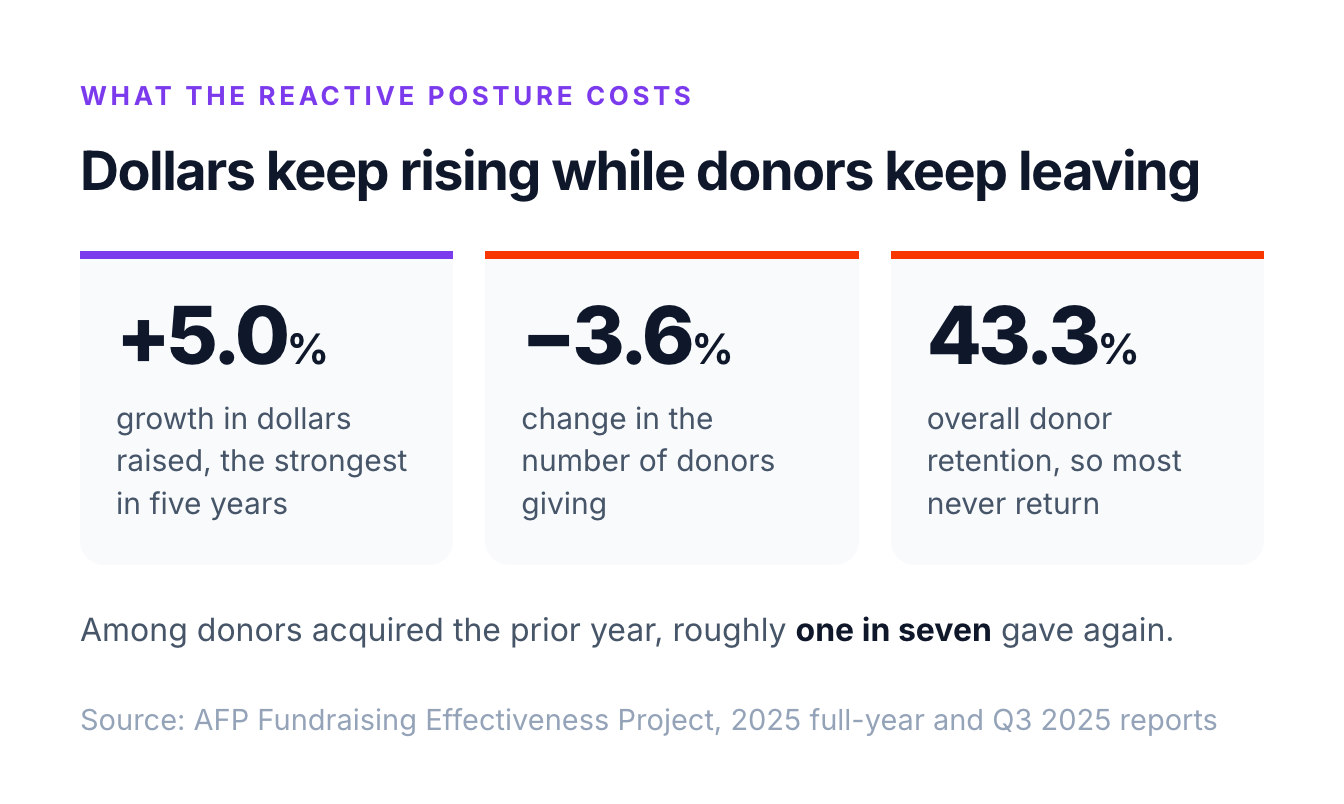
The Fundraising Effectiveness Project’s full-year 2025 data shows the broader challenge facing fundraisers: dollars raised increased 5.0%, while the number of donors declined 3.6%. Overall donor retention was just 43.3%, and only 14% of donors acquired in 2024 had made a second gift by Q3 2025.
At the same time, CASE reported that U.S. higher education raised $78 billion in FY2025, while donor counts declined for the fourth consecutive year. Even more striking, 89% of all funds came from just 2% of donors.
The implication is important. Finding those high-capacity donors matters more than ever. But identifying them requires research, and the people responsible for that research are already operating at capacity.
The next major donor may already be sitting somewhere in the other 98% of the database. The problem is that no one has had the time to find them.
What changes with AI prospect research?
AI prospect research changes the capacity equation.
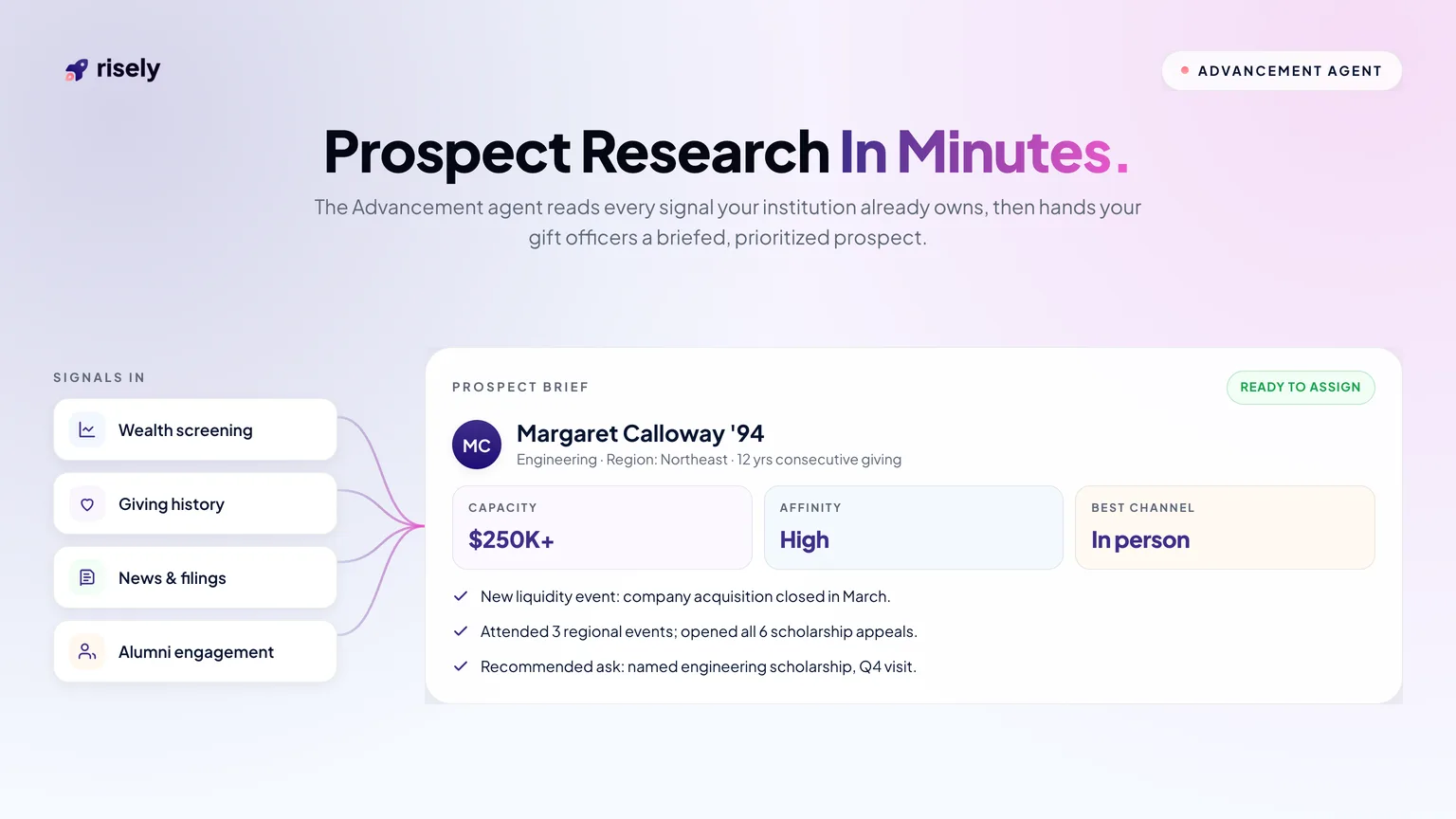
Instead of spending an hour assembling a prospect brief, an AI agent can pull together the initial research framework, wealth indicators, giving history, relationships, and other relevant signals in about a minute.
The researcher keeps the judgment work. The agent takes the assembly, so their hours go to validation, interpretation, and strategy.
In practice, that means:- A research framework in about a minute: a prospect research framework is drafted while the request is still being made
- The full picture in one place: wealth indicators, giving history, connections, and capacity are brought together on a single screen
- Sourced findings: claims are shown alongside their sources, so researchers spend less time hunting for information and more time evaluating it
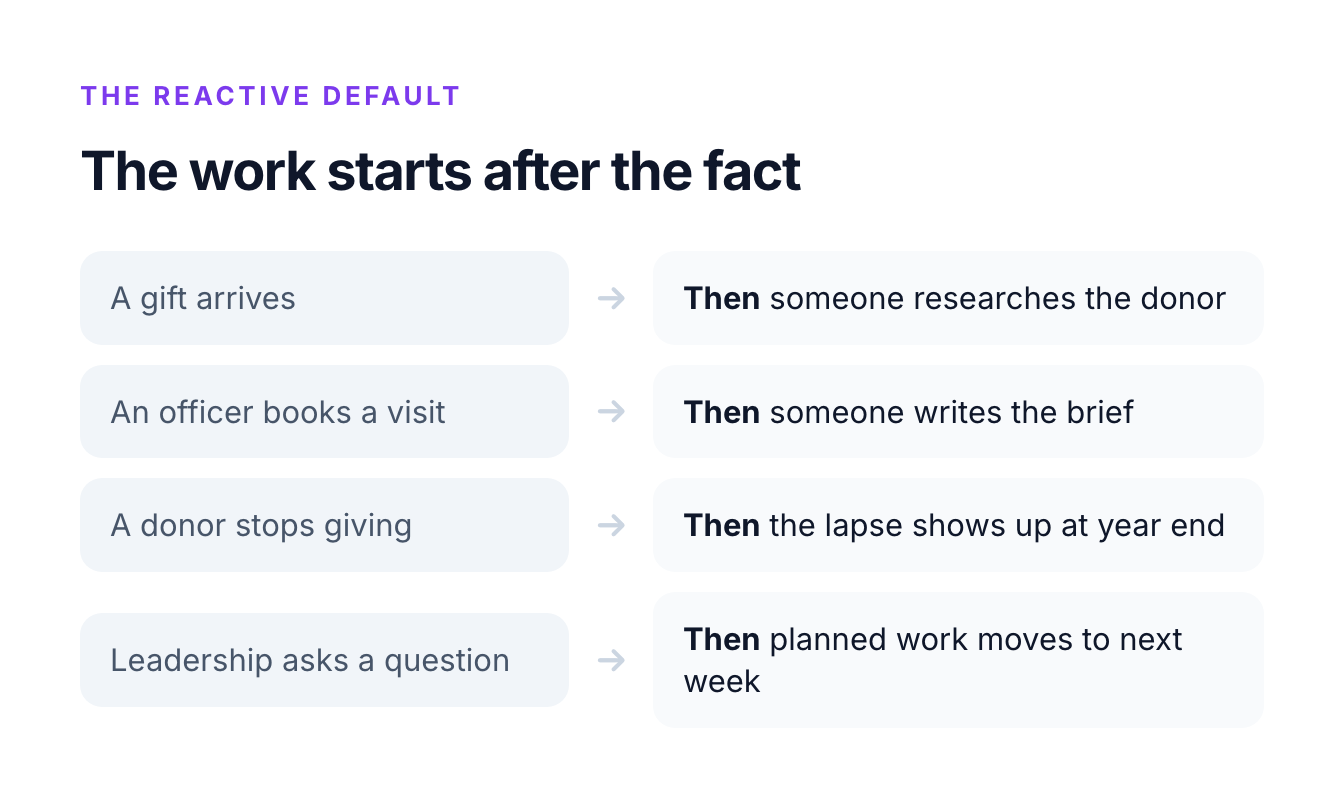
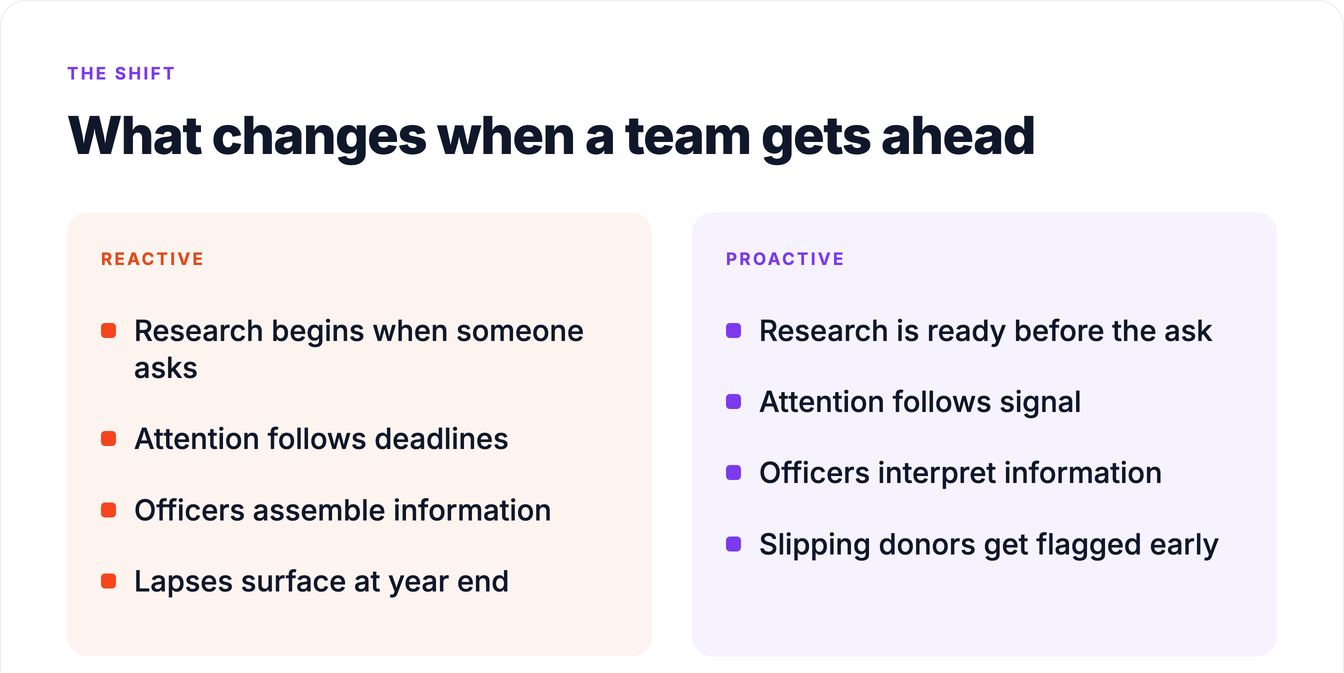
- Research triggered by real-time signals: a new gift, job change, or news mention can trigger research while the opportunity is still relevant
- More coverage across the database: researchers can go beyond the top of the portfolio and identify potential major donors who may otherwise never get researched
The biggest change is how many people the team can research. Volume of briefs becomes volume of prospects covered.
What happened at Westmont?
Westmont College had recently surpassed its $250 million campaign goal while operating with roughly one-third the advancement staff of a comparable institution.
The research team faced the same constraint: one researcher supporting a large alumni and parent population.
After implementing Risely, the results were significant. In twelve weeks:- Research framework creation dropped from about one hour to 66 seconds
- Average time per prospect brief fell from one hour to 31 minutes
- The number of research tools open simultaneously dropped from four or more to one
- The researcher produced 121 prospect briefs
- Overall prospect research capacity increased 4×
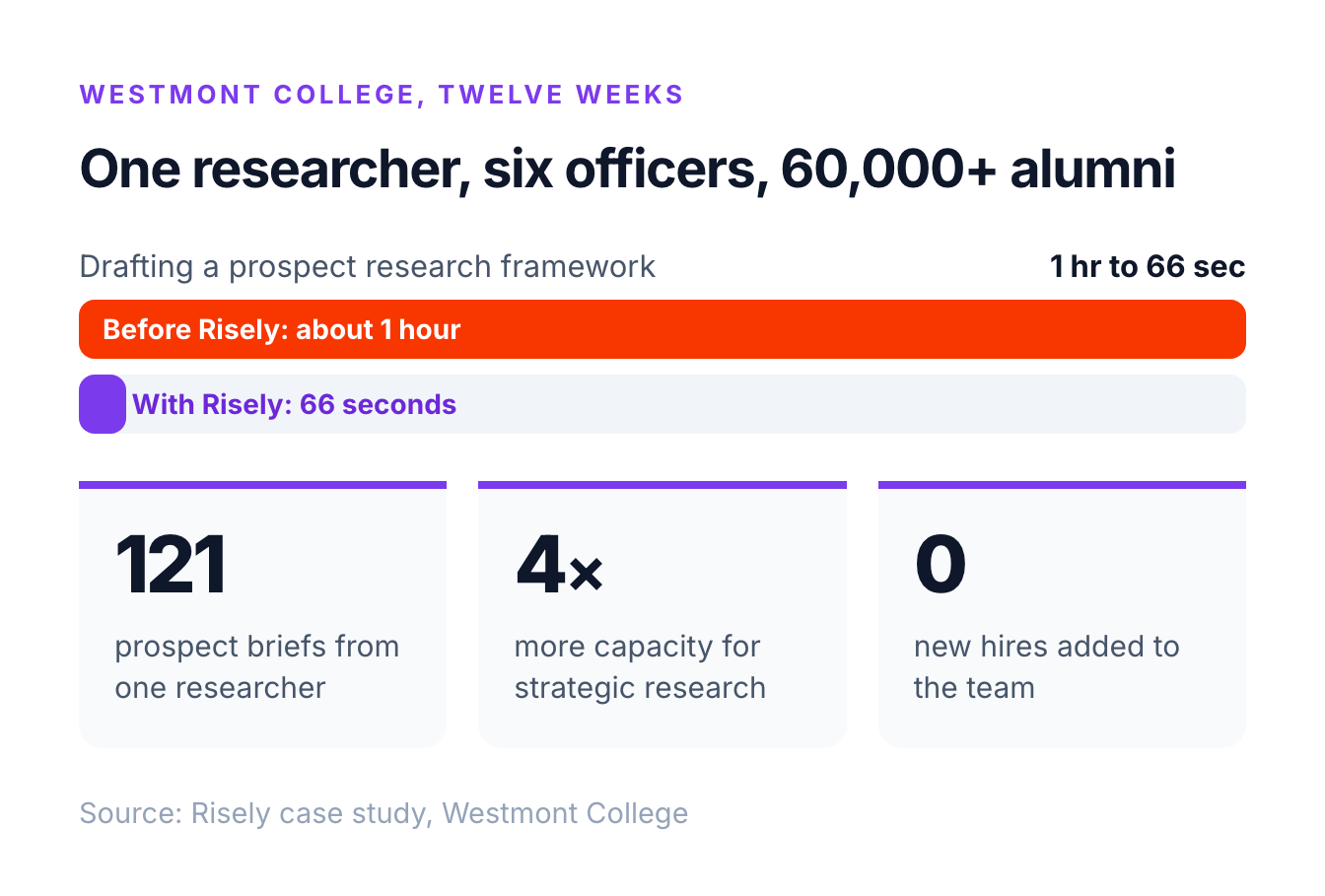
The most important result was reach. The team could act on opportunities that would once have stayed in the queue.
“The fact that I can use it when I see a gift come in and address that right away. That’s something I’ve always been wanting to be able to do and just never had the capacity to do as a one-person shop.”
Neil Di Maggio, Director of Advancement Research, Westmont College
That is what AI changes for a lean research team. It moves research from “we’ll get to it when we have time” to “we can research it when the opportunity appears.”
The real opportunity: researching the people you never had time to research
Every advancement database holds prospects nobody has had the time to look at. A promotion, a business going public, an old donor whose capacity has grown since the last gift. The signals are there, and finding them at scale is the hard part.
One researcher needs the capacity to work like a team of ten. That is what Risely’s advancement agent is built to do: assemble the research, surface the signals, bring wealth, giving, and relationship data together, and show the source behind every finding.
At Westmont, that meant 4× more prospect research capacity with the same team. Read the full Westmont case study.